




Aluminum sheet, coil and foil of Haomei Al. are widely used in automotive, transportation, printing, construction, packa...more >>

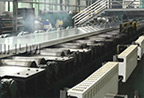
Haomei Al. is a large-scale listed company of aluminum sheet, aluminum coil and aluminum foil manufacturing, and the ann...more >>
Aluminum sheet for construction are standard exterior enclosure and decoration materials for modern public buildings, commercial real estate, and municipal engineering projects. With their core advantages such as lightweight, high weather resistance, high design flexibility, and low total life-cycle cost, they have gradually become a mainstream alternative to stone, ceramics, and color-coated steel. Unlike industrial and residential decorative aluminum sheets, construction aluminum sheets must simultaneously meet three major engineering requirements: structural safety, weather resistance and durability, and aesthetic appeal. From substrate selection and surface treatment to forming and processing, they strictly adhere to building engineering specifications. They are high-end engineering aluminum materials that combine functionality and design.
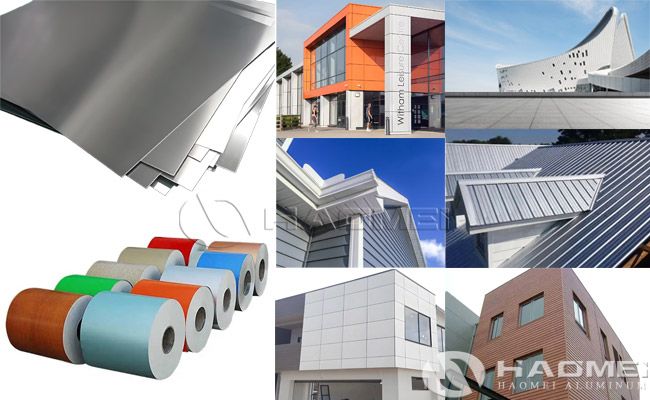
The core performance indicators of aluminum sheet for construction directly determine their suitability for engineering projects and their service life, and must strictly comply with industry standards. For the base material, the mainstream choice is 3003-H24 aluminum-manganese alloy, with a tensile strength of 140-180MPa and an elongation of ≥8%, balancing processability and structural wind pressure resistance. In highly corrosive coastal areas, 5052-H32 aluminum-magnesium alloy is preferred, offering over 40% improvement in salt spray resistance. Surface treatment is crucial for performance: exterior walls are standardly equipped with a PVDF fluorocarbon coating, with a dry film thickness of 40-60μm, UV aging resistance ≥20 years, and salt spray resistance ≥4000 hours. Interior walls mostly use polyester powder coating, with a film thickness of 60-100μm, offering strong color adhesion and meeting environmental standards. Regarding dimensional accuracy, the length and width tolerance of standard building panels is ≤±0.5mm, and the flatness deviation is ≤0.5mm/m, meeting the requirements for tight-fitting installation in engineering projects.
Based on engineering function and structural form, aluminum sheets for construction form a multi-tiered product system to adapt to different architectural needs.
Single-layer aluminum sheets are the most common type of exterior wall material. Formed as a single piece through bending and welding with stiffening ribs, they offer excellent wind pressure resistance and are suitable for various building facades, including flat and curved surfaces. They are the preferred material for curtain walls in commercial complexes, office buildings, and stadiums.
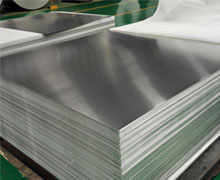
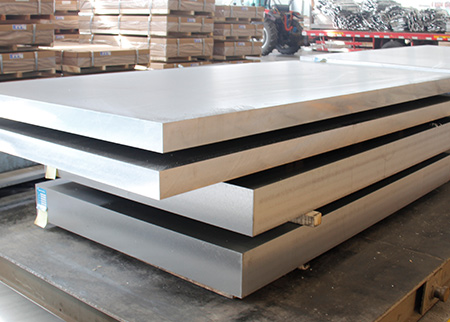
Flat aluminum sheets are a basic product with a flat surface and uniform specifications. They can be cut and bent on-site and are widely used for interior ceilings, wall cladding, and equipment cladding, offering excellent cost-effectiveness.
Corrugated aluminum sheets are roll-formed into a corrugated shape, providing excellent waterproofing and drainage performance. Their lightweight structure makes them the mainstream choice for roofing and wall cladding systems in large stadiums and industrial plants.
Anti-slip aluminum tread plate sheets have a textured surface with excellent anti-slip and wear-resistant properties, primarily used for building walkways, stair treads, and outdoor platforms.
The selection of aluminum sheets for construction requires precise matching to the application scenario to ensure the optimal balance between performance and cost. For exterior curtain wall projects, 2.5mm thick 3003 fluorocarbon coated aluminum sheets are typically used for standard heights, while 3.0mm thick 5052 alloy aluminum sheets are upgraded for super high-rise buildings or areas prone to strong typhoons. Interior ceilings and walls primarily use 1.5mm-2.0mm thick polyester-coated flat aluminum sheets, balancing cost and aesthetics. Roofing systems utilize 0.8mm-1.2mm thick corrugated aluminum sheets with a standing seam structure for waterproofing and seepage prevention. Custom-designed aluminum sheets with double-curved or perforated designs are also available to meet the personalized design requirements of landmark buildings.
As a professional exporter of aluminum sheet for construction, all our products are manufactured in strict accordance with ASTM B209, EN 485, and international architectural curtain wall standards. Each batch undergoes quadruple testing for coating adhesion, color difference, weather resistance, and mechanical properties, and we can provide complete engineering quality inspection reports and export customs clearance documents. We support full-color customization and custom-made non-standard sizes for RAL products, covering a full range from standard flat sheets to engineering aluminum sheets. This allows us to meet the material selection needs of different climates and building types worldwide, providing overseas engineering clients with stable and reliable one-stop architectural aluminum supply solutions.
live:onlinehcx




 Haomei Aluminum
 live:onlinehcx
 +8637165621391