



Aluminum sheet, coil and foil of Haomei Al. are widely used in automotive, transportation, printing, construction, packa...more >>


Haomei Al. is a large-scale listed company of aluminum sheet, aluminum coil and aluminum foil manufacturing, and the ann...more >>
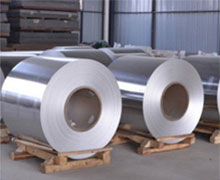
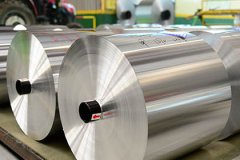
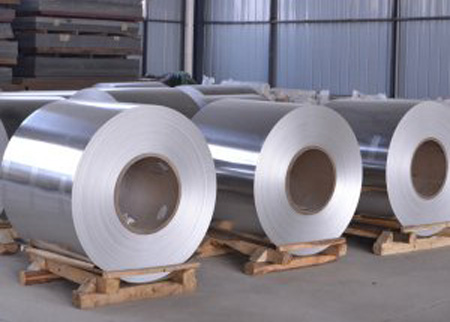
Hot water pipes are the core distribution carriers for municipal centralized heating, industrial waste heat recovery, and building HVAC systems. They operate under complex conditions of high-temperature circulation, alternating temperature differences, and moisture coupling. Ordinary covering materials are prone to problems such as high-temperature creep, thermal expansion and bulging, and moisture intrusion leading to insulation layer powdering and failure, directly affecting heating efficiency and system lifespan. Haomei Aluminum has specifically developed a series of aluminum cladding roll for high-temperature hot water pipelines. With high-temperature stability, resistance to thermal deformation, and long-term moisture barrier protection as core design principles, aluminum cladding for hot water pipe insulation are fully compatible with 70℃-180℃ civil and industrial hot water pipelines. They are a standardized core material for insulation systems in global heating projects, and product performance meets the ASTM B209 international industrial material standard.
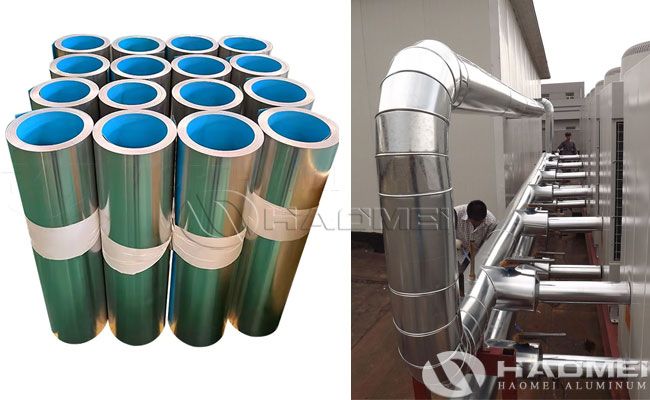
The main grades of aluminum cladding for hot water pipe insulation are 1060 high-purity aluminum and 3003 aluminum-manganese rust-resistant alloy, both of which have passed high-temperature condition verification. The 1060-H14/H18 grade aluminum has a purity of ≥99.6%, a base material melting point of 660℃, and can withstand long-term operation at 150℃ without softening or creep. Its tensile strength is stable at 85-110MPa, with standard thicknesses ranging from 0.3mm to 1.5mm. 0.5mm and 0.8mm are the mainstream choices for municipal heating, offering significant cost-effectiveness and suitable for residential buildings, secondary heating networks, and other conventional hot water applications. The 3003 alloy grade, with the addition of 1.0%-1.5% manganese to refine the grain, offers over 25% higher high-temperature structural strength compared to 1060, significantly improving creep resistance and resistance to damp heat corrosion. It is stably compatible with 180℃ industrial high-temperature hot water and waste heat recovery pipelines, making it the preferred base material for heating projects in coastal high-humidity areas. The thickness tolerance of the entire series is controlled within ±0.02mm, and coil weight and width can be customized as needed.
Based on the protection level requirements of different laying environments, aluminum cladding for hot water pipe insulation are developed using three main processes.
High-efficiency, smooth-surface aluminum claddings have a clean and dense surface, resulting in strong joint sealing after overlapping. With a mirror-like heat reflectivity exceeding 85%, they effectively reduce radiative heat loss in pipelines, making them suitable for regular hot water pipelines in indoor machine rooms and underground pipe corridors.
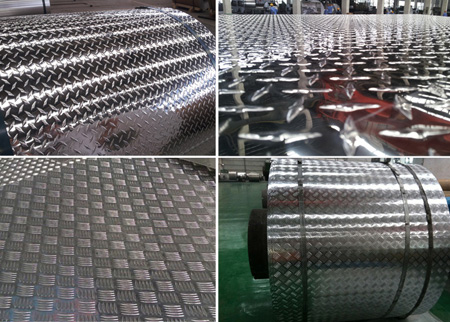
Orange-peel embossed aluminum claddings, formed through roll pressing, enhance the longitudinal rigidity of the sheet material, buffering alternating stress from thermal cycles and preventing bulging and cracking at joints caused by long-term thermal expansion and contraction. They are specifically designed for outdoor, overhead, long-distance heating main pipelines.
Weather-resistant coated aluminum coils feature a composite heat-resistant protective film that combines UV protection and moisture barrier capabilities, delaying material aging in outdoor environments and preventing rainwater and moisture from penetrating the insulation layer and causing powdering. They are the primary protective material for outdoor hot water pipe networks.
Compared to ordinary aluminum insulation materials, aluminum cladding for hot water pipe insulation achieves multi-dimensional performance optimization for hot water applications:
First, it boasts excellent high-temperature dimensional stability. The sheets undergo specialized heat treatment, ensuring a linear expansion coefficient highly compatible with high-temperature insulation substrates such as rock wool and glass wool, preventing warping and delamination under alternating temperature differences.
Second, it exhibits outstanding heat loss control capabilities. The high-reflectivity aluminum surface, combined with a sealed encapsulation structure, can help reduce pipe radiative heat dissipation by more than 15%, improving system heating efficiency.
Third, it demonstrates strong resistance to damp heat aging. The dense self-oxidizing film on the aluminum surface resists high-temperature moisture corrosion, preventing rust and powdering, and extending its service life far beyond traditional sheet metal cladding.
Fourth, it is inherently safe. The aluminum material is a Class A non-combustible material, fully meeting fire safety standards for heating rooms and industrial plants.
Haomei aluminum cladding for hot water pipe insulation offer excellent bending, seaming, and cutting performance, adapting to various pipe diameters and irregularly shaped fittings, significantly improving on-site construction efficiency. Before leaving the factory, they undergo multiple tests for temperature resistance, salt spray, and adhesion, ensuring stable and reliable quality during sea transport and construction. Under normal operating conditions, the product has a service life of 15-20 years, requiring no painting and infrequent maintenance, which can significantly reduce the overall operation and maintenance costs of the heating system.
As a source aluminum product manufacturer, Haomei Aluminum supports customized production of all specifications, with complete export quality inspection and logistics solutions, and can adapt to heating engineering standards in various regions around the world, providing customers in the municipal, industrial, and commercial building sectors with stable high-temperature pipeline insulation solutions.
live:onlinehcx



 Haomei Aluminum
 live:onlinehcx
 +8637165621391